37.72°N — 12.88°E · Western Sicily
"This is the valley I chose. Not the postcard Sicily, not Taormina at golden hour — the Belice. Rebuilt after the 1968 earthquake, still overlooked by nearly every guidebook, and quietly one of the most extraordinary corners of the Mediterranean. I live here. I work here. And I've made it my life's work to bring it to the world — carefully, and on its own terms."
The Place
The Belice Valley is a river-carved stretch of western Sicily — a triangle running roughly from Marsala to Sciacca to Corleone, holding the towns of Partanna, Gibellina, Menfi, Sambuca di Sicilia, Salemi, Santa Margherita di Belice, Poggioreale, and Castelvetrano. It is farmland and olive groves and low chalk-white hills. It is also, structurally, one of the youngest landscapes in Italy — because on the night of January 14, 1968, an earthquake destroyed most of it. Villages that had stood for centuries collapsed within minutes. Tens of thousands of families lost their homes; many left for Queens, for Toronto, for Melbourne, and never came back.
What was rebuilt afterward became — improbably — one of the most interesting architectural and cultural experiments in postwar Europe. Ludovico Corrao, the mayor of the destroyed village of Gibellina, invited the most important Italian artists of the twentieth century to help him imagine a new town from scratch. Alberto Burri, Pietro Consagra, Arnaldo Pomodoro, Mimmo Rotella — they all left permanent works in Gibellina Nuova. Burri poured concrete over the ruins of the old village and created the Grande Cretto, a vast white land-art memorial you can walk through today. Almost no one comes to see it.
That is the Belice in one sentence: astonishing, unfinished, and mostly ignored. Which is exactly why I chose to build a life here.
My husband Nino's family has farmed olives here for five generations. The family's oil — which we still press by hand each November — is the tangible proof that this valley is not "abandoned Sicily." It is living Sicily. It is where the wine is made without shortcuts, where the ricotta is warm the morning it's carried down the street, where you can still be invited into a stranger's home and served food that took three days to prepare. It is Sicily as Sicilians actually live it — not curated for tourism, not dressed up for a camera. And that is the exact thing I built Isola Marea to protect and to share.
The Towns
These are the towns I take guests to. None of them are on the standard Sicily itinerary. All of them are worth a day, and several are worth a week. Each has a reason to exist — and a reason travellers, once they arrive, say they'd have missed all of Sicily by skipping it.
Trapani Province · My Mother's Birthplace
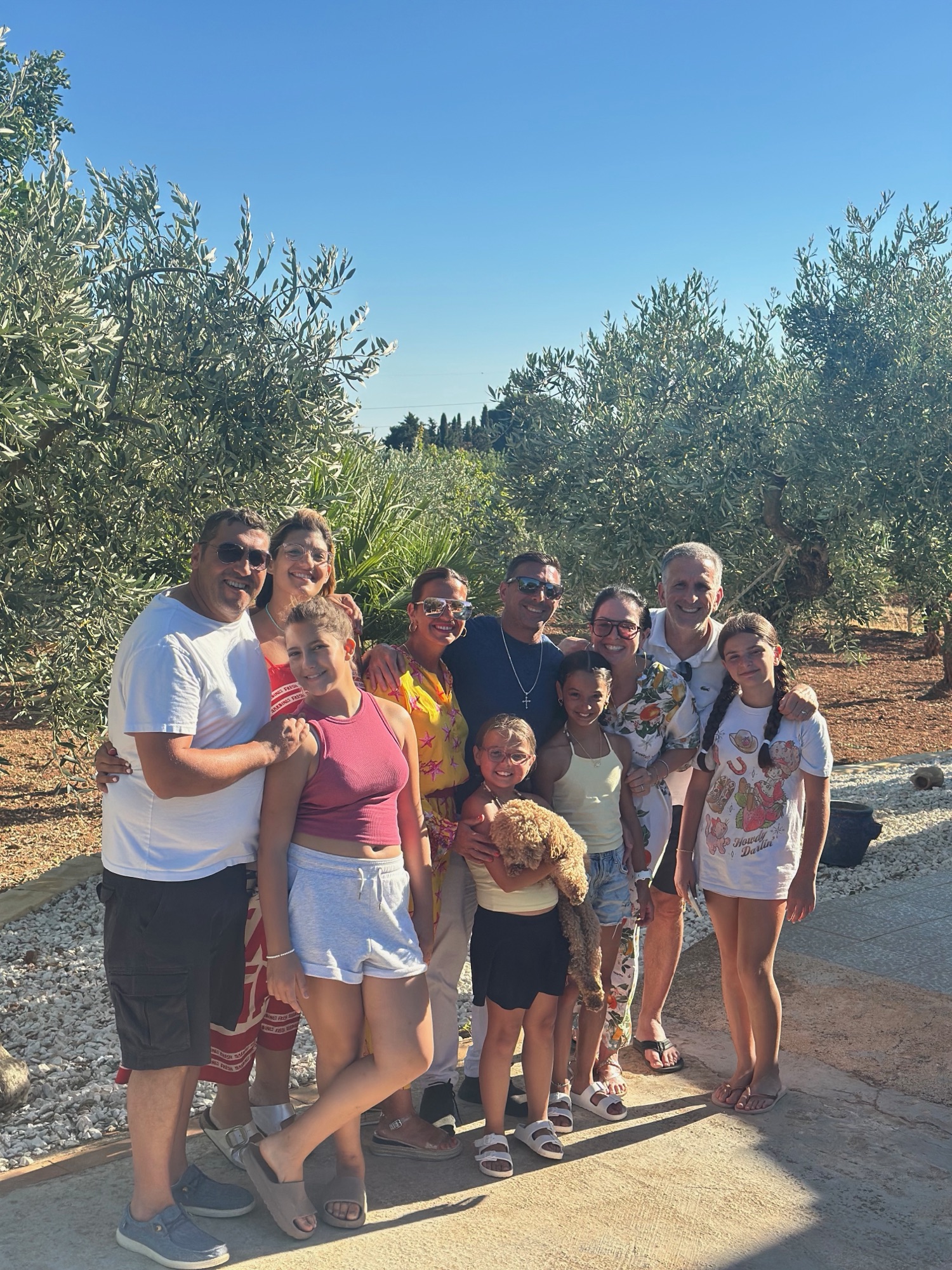
My mother was born here. I met my husband Nino here. It is where the two of us now live with our children — a hilltop town of 10,000, medieval castle at its centre, surrounded by the olive groves that produce our family's oil. Sicilian is still the everyday language in the bar. Isola Marea is based here — and every guest is welcomed into the family kitchen.
Agrigento Province · My Father's Birthplace
My father was born here. The old town was destroyed in the 1968 earthquake and rebuilt a few kilometres away — a village whose story tracks exactly with mine: those who left after the collapse, those who came back. The ruins of the old town are still walkable. It is the most personal stop I make with heritage guests.
Trapani Province
Rebuilt from zero after 1968 as a museum in the shape of a town. Home to Consagra's steel Stella, Pomodoro's spheres, Beuys' installations, and Burri's Grande Cretto — a 12-hectare land-art memorial poured over the ruins of old Gibellina. One of the most important sites in postwar European art. Almost nobody visits.
Agrigento Province
Coastal wine country. Blue-flag beaches, the natural-wine estates of the Planeta family and Cantine Barbera, and one of the finest slow-food cultures on the island. A quieter alternative to the Mount Etna wine circuit — and closer to the sea.
Agrigento Province
Officially designated a Borgo dei Borghi, one of Italy's most beautiful villages. Arab-Norman streets, a Baroque piazza, Cellaro wines, and Lake Arancio for spring hikes. The town that first tried the €1-house experiment — but the real story is what happened to the place afterward.
Trapani Province
The town Garibaldi briefly declared capital of Italy in 1860. A hilltop borgo built in tuffo stone with a rescued Norman castle and the ovens where the town's Easter pani di San Giuseppe — bread as sculpture — are still baked. Historically and gastronomically extraordinary.
Agrigento Province
The village at the heart of Tomasi di Lampedusa's Il Gattopardo. The Filangeri-Cutò palace has been restored as a museum of the novel. If The Leopard matters to you, this is a pilgrimage. If it doesn't yet — visit and it will.
Trapani Province
The ghost town. When Poggioreale was destroyed in 1968 the villagers rebuilt a new town a few kilometres away, leaving the original streets and houses to erode in place. Walking the ruins is one of the most quietly powerful hours you can spend in Sicily. Never crowded.
Trapani Province
The largest archaeological park in Europe — Greek temples on a cliff above the sea, without the crowds of the Valley of the Temples. Castelvetrano itself is the home of the Nocellara olive, the black bread of Sicily, and (recently) a slow revival of its historic centre.
Trapani Province
Another town destroyed in 1968 and rebuilt piece by piece. Above it sits the Riserva Naturale della Grotta di Santa Ninfa — one of Sicily's most extraordinary karstic cave systems, quietly accessible to walkers who know it's there. Sheep country, cheese, and stillness.
Trapani Province · Olive Country
The heart of Nocellara del Belice DOP olive country — the same fruit that produces our family's oil. Above the town sits Cave di Cusa, the ancient Greek quarry whose stone became the temples of Selinunte — columns still lying half-cut in the field where the quarrymen left them 2,500 years ago. Almost nobody visits.
Trapani Province
A quiet hilltop village of 2,000 people, entirely agricultural, entirely Sicilian. This is what a Belice village looks like when it hasn't been discovered — nothing curated, nothing performed, and (for the traveller with roots here) the possibility of finding a surname above a bar.
Agrigento Province · Coast
A working thermal-spa and fishing town on the Agrigento coast — famous for the loudest Carnival in Sicily, Baroque churches, and centuries of ceramic-making. Once a Grand Tour stop, since fallen from the guidebooks — which means the beaches, the natural-wine bars, and the fishermen are back to being for locals.
Palermo Province · Arbëreshë Community
One of Sicily's Arbëreshë villages — descendants of fifteenth-century Albanian refugees who kept their Byzantine-rite Catholic liturgy, their language, and their food. Just below the town sits Rocca di Entella, a mountaintop site with layered Elymian, Greek, and Norman ruins. Cinematic and almost empty.
Agrigento Province
A hilltop town at 950 metres, wrapped around a dramatic rock spike crowned by a Norman sanctuary. The 1302 Peace of Caltabellotta was signed here, ending the war of the Sicilian Vespers. The views run all the way to the sea, and the drive up is one of the most beautiful in western Sicily.
The Return
The reactions are consistent enough that I've learned to expect them. There is a moment — usually the second day, usually at a family table — when a guest's shoulders drop. They sit back deeper into the chair. Sometimes they get emotional. Their eyes change. It is the physical sign of a person arriving somewhere they didn't know existed and recognising it anyway. This is what the Belice does to people.
"I don't know what I would have done without you. This wasn't a trip. It was a return I didn't know I needed."— Guest, Boston · June 2026 · Hosted Sicily
"I've been to Sicily three times before and never left the eastern coast. I had no idea any of this existed. The valley, the family, the oil — it's the trip I'll be talking about for the rest of my life."— Guest, San Francisco · September 2026 · Hosted Sicily
"Standing inside the Cretto at Gibellina I understood something about my grandparents' generation that no one had ever explained to me. Josephine knew that would happen. That's the difference."— Guest, Toronto · May 2026 · Heritage & Return
Track Record
I don't approach potential partners as a newcomer to the Valley. These are the collaborations I've led or delivered — with the institutions, cultural bodies, and communities that already know the work.
GAL Valle del Belice · Spearheaded
I spearheaded the Belice €1 Weekend — a leisure-and-learning vacation programme funded by GAL Valle del Belice as a deliberate play on the international €1-house narrative. Winners paid €1 for a weekend inside the Valley. Applications closed at 100; 15 winners were selected. Their stays became a body of organic content — reels, posts, and stories — that brought sustained visibility to towns most travellers never reach.
GAL Valle del Belice · Official Host
When the Foreign Press Association's Premio Stampa Estera came to the Valley, I acted as official host on behalf of GAL Valle del Belice — welcoming international journalists, coordinating cultural programming, and representing the region to a global press audience.
Sicily Cultural Heritage Festival · Experience Provider
Recognised experience provider through Vie dei Tesori — Sicily's most significant cultural-heritage festival, which each autumn opens privately-held and specialist sites to the public. A vetted institutional trust marker from one of the island's most credible cultural bodies.
Isola Marea · Original Experience
I created and lead the Belice Valley's Rural Food Tour — a proprietary Isola Marea experience that celebrates the Valley's three foundational agricultural products, guiding guests directly to the fields, the mills, and the tables where they are still made the way they have been for generations. Not replicated anywhere else.
Belice Valley · 2026
Travellers brought directly into the Valley through Isola Marea in a single year. Not statistics — 150 real people who stayed in Belice hotels, ate at Belice tables, bought from Belice producers, and left telling the story of what they found here.
Partnership
If you are a mayor, a marketing director at a winery, a cultural association, or a tourism board in western Sicily — I want to hear from you.
I built Isola Marea because I believe the Belice Valley deserves a real place on the international travel map, and because I refuse to accept the alternative — that the towns I love become depopulated, misunderstood, or reduced to a €1-house punchline in the international press. I am a Sicilian-American storyteller, a Fora-certified travel advisor with a North American clientele, and — through my growing personal brand @giusybella_in_sicily — a content creator whose audience is exactly the kind of traveller you want.
I partner with local entities on:
I do this work because I believe in the place, and because I want my two children to grow up watching their mother build something durable in the town their great-grandfather left. If your organisation has a project that would benefit from a partner who lives here, works here, and knows how to speak to the international traveller — let's talk.
For Travellers
My Hosted Sicily trips run four months of the year, six to eight travellers per group. I plan every day personally, host you inside the family, and open doors that don't open for outside groups.
Plan a Hosted Trip →For Local Partners
Content, storytelling, group hosting, cultural promotion, representation abroad. If you're a mayor, a producer, a cultural association, or a tourism board — I respond to every enquiry personally.
Send a Partnership Enquiry →